
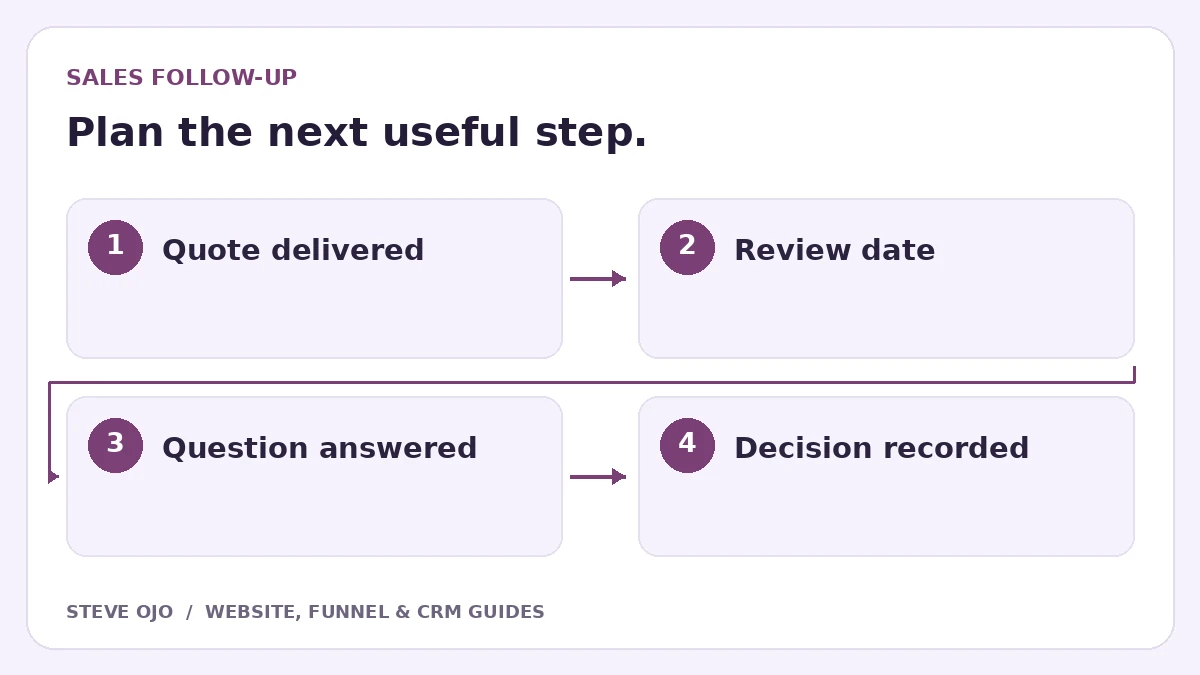
A quote follow-up email should help the customer make the next decision, not merely remind them that your business wants an answer. Refer to the actual proposal, ask a useful question and give them a simple way to reply. Build the reminder around the agreed buying process and stop it when the situation changes.
Check delivery and the agreed timeline first
Confirm that the correct person received the current quote and that its scope, validity and next steps are clear. If you agreed to follow up after a site visit or internal meeting, respect that timing. There is no single reminder interval that suits every service.
Use the quote system or a recorded staff action to establish delivery. An email-open signal is not a reliable statement of customer intent. If the proposal changed, link to the current version rather than sending contradictory attachments.
First follow-up: offer help with the decision
Hi Alex, I’m checking that you received the quote for [specific work]. Is there anything in the scope, timing or next step you would like me to clarify? You can reply here, or let me know a suitable time for a short conversation.
Thanks,
[Name]
Replace every placeholder and add only information the customer can verify. This message invites a question without pretending the person has read the proposal or promising availability the team has not reserved.
Later follow-up: close the loop respectfully
Hi Alex, I’m updating our project list and wanted to check whether you are still considering [specific work]. If the timing has changed, that is fine. Let me know whether you would like to discuss it, revisit it later or close the enquiry for now.
Thanks,
[Name]
Do not invent a deadline or scarcity claim to force a response. If the quote has a genuine expiry date, reference the agreed terms and explain that revised pricing or availability may need confirmation.
Connect the sequence to proposal status
Only enroll opportunities with an actual quote sent and an appropriate follow-up basis. Exit on approval, decline, relevant reply or a staff pause. A customer asking a question should move into a human conversation, not receive the next automated chase the following morning.
Tools such as Jobber document quote follow-up features, but the business still needs to define when those reminders are appropriate. Keep a next-action date and responsible owner so a sequence failure does not make the enquiry disappear.
Test the four outcomes before enabling reminders
- No response: the planned reminder is sent once.
- Customer replies: a human task appears and chasing pauses.
- Quote approved: proposal reminders stop and the agreed next process begins.
- Quote declined: the outcome is recorded without a welcome sequence.
Review replies, decisions and suitable work won separately from email activity. If customers repeatedly ask the same question, improve the proposal itself. A clearer scope or next step can be more useful than adding another follow-up email.
Sources and product documentation
Product details checked 27 October 2026. Confirm current plans and the exact behaviour in your account before implementation.
Need help applying this to your business?
Steve Ojo designs websites, funnels and connected CRM workflows, working remotely from Nigeria. Share your current process and the outcome you need.
Explore the related service Discuss your project