
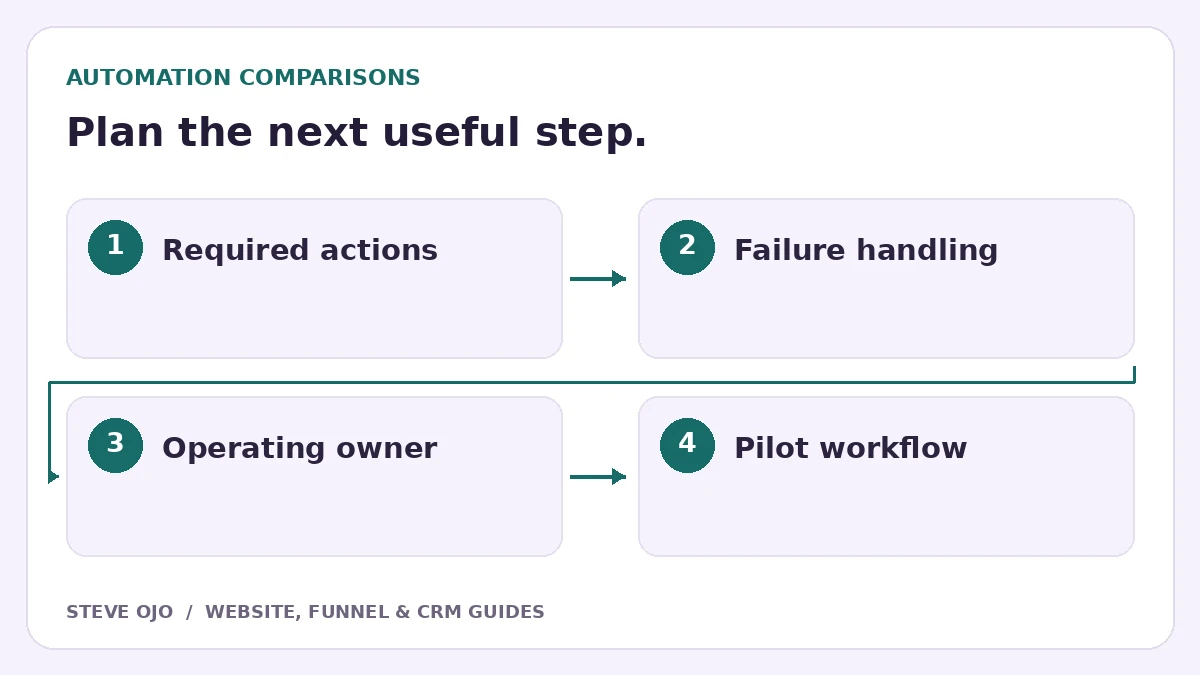
The best automation tool is the one that supports your required actions and can be maintained by the people responsible for it. Zapier, Make and n8n can all connect business processes, but their workflow models and operating responsibilities differ. Compare one real workflow rather than choosing from a feature-count headline.
Check exact actions, not just app logos
Write the workflow as a sequence: receive a request, look up a contact, create or update an opportunity, assign an owner and send a notification. Verify that each platform supports the exact operations and fields you need, including search, updates and any custom API work.
An app appearing in an integration directory does not mean every endpoint is available. Test a returning customer, a missing field and an expired connection. Include the account permissions and plans required by the connected apps, not only the automation subscription.
Compare the operating model
| Tool | Decision to test | Responsibility to budget |
|---|---|---|
| Zapier | Required triggers/actions and task usage | Connection maintenance, errors and replay |
| Make | Visual branching, filters and data mapping | Scenario monitoring and failure routes |
| n8n | Cloud or self-hosted setup and required nodes | Workflow maintenance; infrastructure if self-hosted |
This is a selection framework, not a scored performance test. Plan availability and pricing can change, so confirm the current account requirements before buying.
Understand branching and retries
Make routers branch bundles through filters and can use a fallback route; the documented routes execute sequentially. Check overlapping conditions so one request does not unexpectedly reach several business destinations.
Zapier distinguishes failed-step replay from full-run replay. Repeating an entire run can repeat successful actions, so add a stable source identifier and check for an existing record before creating another. Design duplicate protection around the business action, not just the expectation that failures are rare.
Treat self-hosting as an ownership decision
n8n offers managed Cloud and self-hosted options. A free Community edition does not make hosting, backups, upgrades and incident handling disappear. Choose self-hosting only when someone can own those duties and the business approves the arrangement.
Managed hosting can reduce infrastructure work, but the workflow still needs an owner. Someone must understand field mappings, monitor failures and update connections when the business changes its tools. A low subscription bill is not the whole operating cost.
Run a small acceptance test before committing
- Build the same useful workflow on the shortlist.
- Test a new record and a returning record.
- Simulate one downstream failure and recover it without duplication.
- Estimate usage from the actual steps and expected volume.
- Ask the future maintainer to diagnose a deliberately broken mapping.
Choose the tool that passes the required process and can be handed over clearly. Document the owner, connected accounts, source identifiers and recovery instructions. The best choice for a solo operator can differ from the best choice for a team with technical support.
Sources and product documentation
Product details checked 27 October 2026. Confirm current plans and the exact behaviour in your account before implementation.
Need help applying this to your business?
Steve Ojo designs websites, funnels and connected CRM workflows, working remotely from Nigeria. Share your current process and the outcome you need.
Explore the related service Discuss your project