
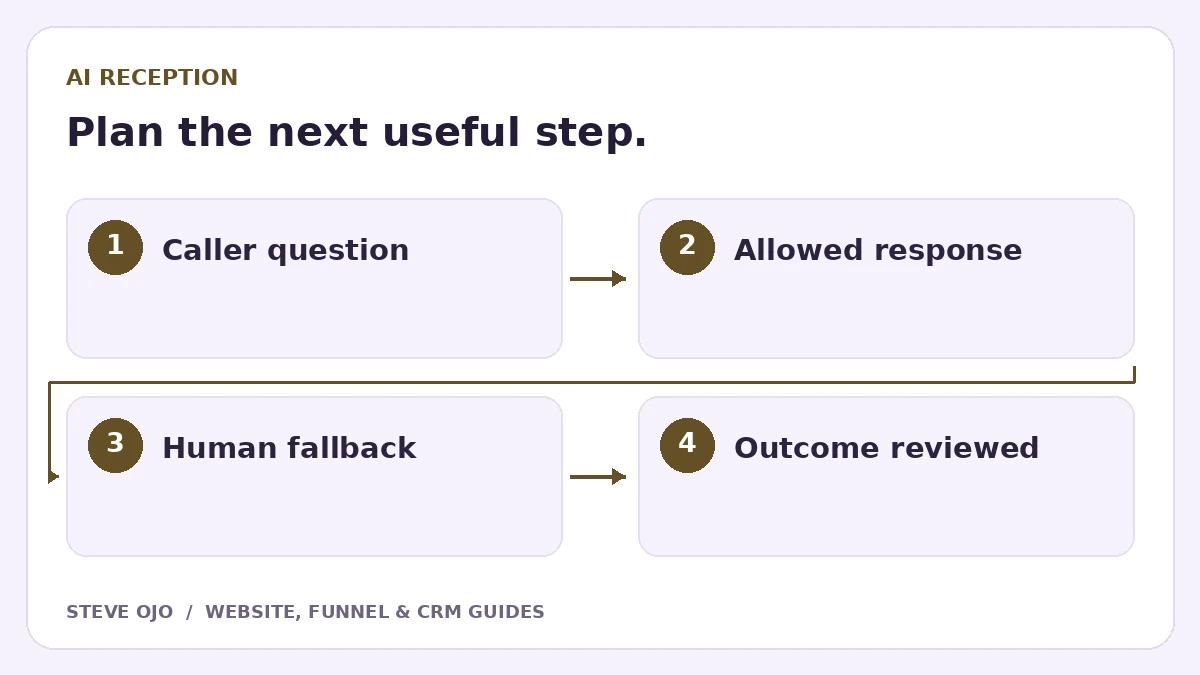
An AI receptionist can do more during a call than a voicemail greeting, but it also needs more boundaries, testing and maintenance. Choose based on the calls your business receives and the team’s ability to manage exceptions. A well-run callback process may be a better starting point than an unmonitored conversational agent.
Start with the jobs callers need to complete
List common call reasons: opening hours, service coverage, appointment changes, quotes and questions needing a person. Mark which answers can be supplied from approved information and which require judgement. That list becomes the scope of any automated receptionist.
Voicemail records a message for later review. An AI agent may answer questions or connect to other tools, depending on the implementation. Do not assume every voice agent can reliably book into your calendar, recognise an existing customer or resolve a billing issue.
Compare the operating responsibilities
| Question | Voicemail | AI receptionist |
|---|---|---|
| Who answers complex questions? | Staff during callback | Staff after an explicit handoff |
| What needs maintenance? | Greeting, inbox and callback ownership | Knowledge, tools, boundaries and call review |
| Can it confirm a booking? | Normally requires a callback | Only with a tested scheduling connection |
| What happens on failure? | Message or alternate contact | Safe fallback to message or person |
Set limits on what the AI can say and do
Provide approved service descriptions, hours and coverage. Define what the agent must not promise: unconfirmed availability, personalised professional advice, guaranteed quotes or a dispatched visit that the business has not accepted.
Make the automated nature of the conversation clear and follow the business’s approved call-handling and recording process. Keep sensitive account changes behind the appropriate verification route. A friendly voice should not be treated as proof that the caller has reached an authorised decision maker.
Design the handoff before the greeting
Decide when the agent transfers, takes a message or creates a callback task. Give the receiving person a concise summary of the caller’s request and what has already been attempted. If transfer fails, the caller needs a clear fallback rather than an endless loop.
For booking, require the scheduling system to confirm the actual time before the agent says the appointment is booked. Distinguish a request from a reservation. Check cancellations and reschedules as carefully as new appointments.
Pilot with a limited scope and review real outcomes
Test a normal query, an unclear request, an unavailable slot, an angry caller and a failed transfer using fictional details. Review transcripts or approved call records for unsupported claims and repeated misunderstandings. Assign a person to update information when services or hours change.
Measure resolved routine requests, appropriate handoffs and completed next steps. Do not judge the pilot only by calls answered or call duration. If the team cannot review exceptions yet, improve voicemail ownership first and add conversational scope gradually.
Sources and product documentation
Product details checked 27 October 2026. Confirm current plans and the exact behaviour in your account before implementation.
Need help applying this to your business?
Steve Ojo designs websites, funnels and connected CRM workflows, working remotely from Nigeria. Share your current process and the outcome you need.
Explore the related service Discuss your project