A landing page focuses on a particular offer and next action. A website gives visitors a broader way to understand a business, explore services and verify its work. You may need both. Choose from the visitor’s task and traffic source rather than assuming one format always converts better.
Understand the practical difference
| Question | Landing page | Website |
|---|---|---|
| Main purpose | Explain one offer and guide one main action | Present the business and its services |
| Typical journey | Campaign → offer → request or purchase | Explore → compare → trust → contact |
| Navigation | Focused on the offer’s supporting information | Connects several meaningful pages |
| Maintenance | Keep the offer and connected process current | Keep the broader service information current |
A landing page can live inside the main website. The distinction is its purpose, not whether it uses a separate domain.
Use a landing page for a specific campaign
A webinar registration, a defined consultation offer or one installation service can benefit from a focused page. The headline, proof and button should all match the reason the visitor clicked. Give enough context to make the decision without adding unrelated offers.
Do not remove useful information just to make the page shorter. Scope, price context, eligibility and what happens next can be essential. A focused page should reduce confusion, not hide the details someone needs to trust the offer.
Use a website when visitors need to explore
A business with several services usually needs a clear way for visitors to find the right one. An about page, real project examples and contact information can help people assess whether the business is suitable. These pages also support referrals who arrive without seeing a campaign first.
Build useful service pages around real differences. Do not publish many near-identical locations or services merely to increase page count. A smaller set of clear, connected pages can be easier for customers and the business to maintain.
Connect both formats to the same operating process
Whether the enquiry comes from a campaign page or a service page, store its source and requested service. Assign the next response, send an honest acknowledgement and define what counts as a confirmed booking or purchase.
If both routes feed the same CRM, prevent duplicate contacts and conflicting follow-up. A returning customer should not receive an unrelated new-prospect sequence because they used a different page. The design and the downstream workflow need to agree on the visitor’s next step.
Choose with a short decision exercise
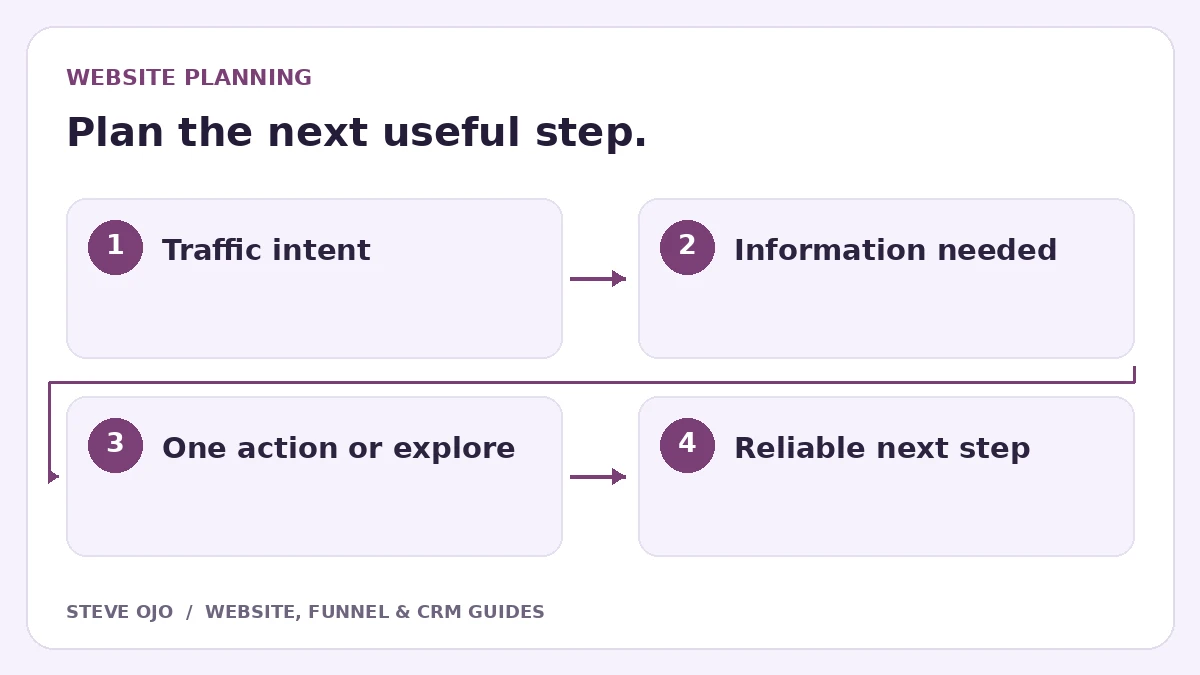
- Name the visitor and the question they are trying to answer.
- List the information needed before the next action.
- Decide whether they need one offer or several service routes.
- Define the action and the system that confirms success.
- Test the complete journey on mobile.
For an example of a focused service offer, see the 4M Plumbing landing-page design. For builder selection after scope is settled, compare the website builder options. Neither page type guarantees rankings or sales by itself; the fit and execution matter.
Sources and product documentation
Product details checked 27 October 2026. Confirm current plans and the exact behaviour in your account before implementation.
Need help applying this to your business?
Steve Ojo designs websites, funnels and connected CRM workflows, working remotely from Nigeria. Share your current process and the outcome you need.
Explore the related service Discuss your project